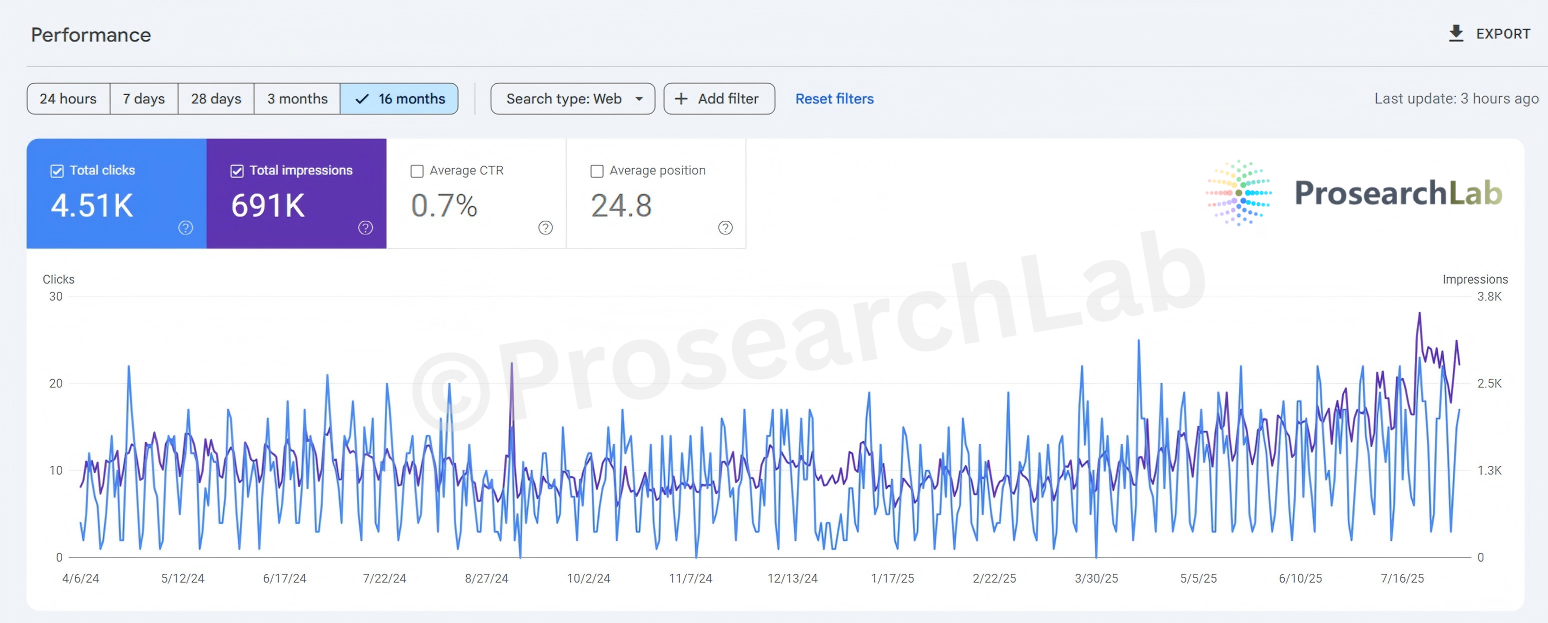
Figure 1: 16-month organic performance showing sustained growth and high-intent B2B engagement patterns.
Client Profile: API & Custom Synthesis Manufacturer (B2B)
Timeline: April 2024 – July 2025
1. Background & Challenge
In the highly regulated pharmaceutical industry, trust is a critical ranking factor. Our client, a mid-sized CDMO specializing in APIs, possessed world-class manufacturing capabilities but lacked the digital authority to match.
Despite having high-quality products, their website was failing to connect with Googlebot. Upon audit, we identified two primary bottlenecks:
- Technical Debt: The product catalog generated thousands of duplicate URLs due to poor parameter handling, leading to severe index bloat.
- Authority Gap: The site failed to meet Google's E-E-A-T standards for YMYL topics, resulting in its content being suppressed in favor of larger aggregators.
Our objective was to restructure the site into an authoritative chemical database, proving to search engines that this data was verified, accurate, and expert-backed.
2. Technical Implementation
Consolidating the Molecule Library
The site previously treated chemical variants (e.g., different pack sizes or purity grades) as separate pages, which diluted ranking potential. We reorganized the catalog into a unified structure. Instead of having five weak pages for one compound, we consolidated them into single master product pages. These now centrally house the CAS number, IUPAC name, and therapeutic applications, effectively eliminating keyword cannibalization.
Establishing E-E-A-T & Data Integrity
To overcome the YMYL barrier, we overhauled the About Us and author sections, explicitly linking internal PhD scientists to their published research. Crucially, we validated product data by adding outbound citations to authoritative databases (like PubChem and FDA.gov) directly on product pages. This signals to algorithms that our chemical specifications are rigorous and verified.
Targeting Technical Intent
High-value buyers search for specifications, not just names. We expanded on-page content to target specific long-tail technical queries, such as "impurity profiles" or "custom synthesis timelines." We also deployed ChemicalSubstance schema markup, helping Google understand the structured data behind the text.
3. Performance Analysis
The GSC data from the 16-month engagement illustrates a clear sanitize and scale trajectory.
The Weekday Pattern
The graph displays a distinct sawtooth pattern—high traffic on weekdays, dropping on weekends. This confirms we are successfully reaching a professional B2B audience during laboratory and office hours, rather than casual weekend browsers.
Timeline Breakdown
- Months 1-4 (The Foundation): Traffic remained flat. This was the remediation phase, where we used
robots.txt to block 150,000 low-quality URLs. We focused on cleaning the index rather than chasing vanity metrics. - Months 5-10 (The Lift): As the new Molecule Library structure was indexed, traffic began to climb. The consolidated pages started gaining traction for core chemical terms.
- Months 12+ (The Compounding Effect): The divergence between impressions (purple) and clicks (blue) in the later months indicates the site is now ranking for thousands of long-tail variations (synonyms, CAS numbers) that were previously invisible.
4. Commercial Outcome
The restructuring turned technical improvements into business value:
- Traffic Volume: Scaled from stagnation to 4.5K+ high-intent clicks.
- Lead Quality: Inquiries from verified biotech domains increased by 300%, confirming the traffic is driving actual pipeline value.
- Market Share: The site now holds the #1 position for over 120 specific CAS number queries, effectively blocking competitors from the top of the funnel.