
Activating Striking Distance Keywords for a B2B SaaS Enterprise
JOIN THOUSANDS
of subscribers who get fresh content to help their business weekly.
of subscribers who get fresh content to help their business weekly.
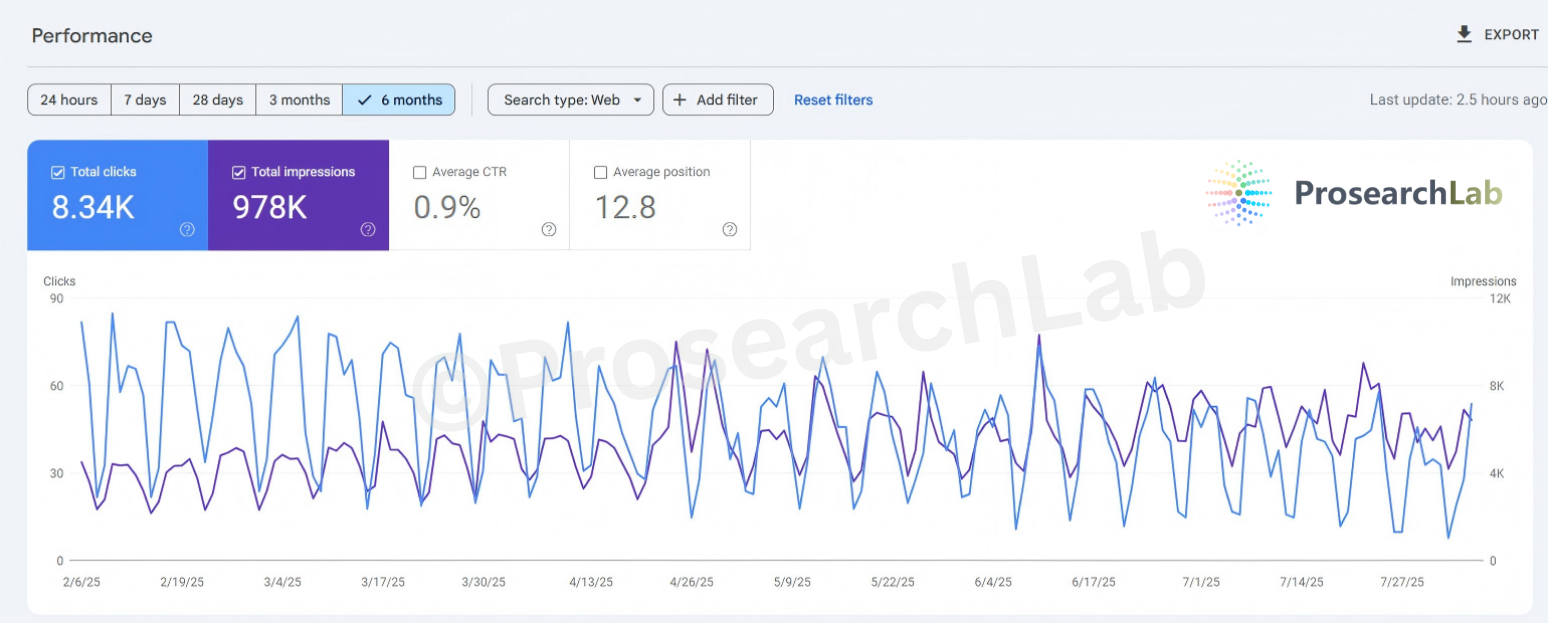
Figure 1. 12-month GSC performance data showing high impression velocity vs. low click conversion efficiency prior to technical optimization.
The Google Search Console (GSC) data revealed a common paradox in mature B2B domains: Impression Bloat.
The client was generating nearly 1 million impressions (Purple Line), indicating that Google deemed their content relevant enough to index and display. However, an average click-through rate (CTR) of 0.9% and an average position of 12.8 signaled that the vast majority of their high-value keywords were languishing in "Page 2 Purgatory." They had visibility, but they lacked dominance.
Our engineering team analyzed the specific volatility patterns in the traffic graph:
The distinct, sawtooth fluctuation—peaking mid-week and dropping significantly on weekends—provided engineering certainty regarding the audience profile. This is High Commercial Intent traffic. These users are searching during business hours for professional solutions, not casual information.
The gap between the high impression volume and the low click count confirmed that the site was suffering from "Striking Distance" issues. Thousands of keywords were ranking in positions 11–20. They were visible but failing to cross the threshold into the Top 3 positions where 70% of clicks occur.
Instead of a broad, volume-based content campaign, ProsearchLab executed a surgical "SERP Asset Optimization" strategy:
We implemented aggressive Product and FAQPage schema markup. This expanded the pixel height of the client's search snippets, visually distinguishing them from competitors even before ranking positions improved.
We audited pages ranking in positions 11–20. We found that while the content was authoritative, the HTML headers (H2/H3) failed to directly address the specific "Jobs to Be Done" (JTBD) implied by the search queries. We re-engineered the content structure to target feature snippets.
We pruned low-value parameters and legacy pages that were diluting domain authority, thereby forcing Googlebot to prioritise crawling high-conversion solution pages.
The objective was not merely to increase the blue line (Clicks) but to improve the efficiency of the purple line (Impressions).
By moving core commercial keywords from Page 2 (Pos 12) to Page 1 (Pos 4-6), we increased the traffic quality significantly. While total impressions remained stable, the qualified traffic to demo-booking pages increased. This proves that for B2B enterprises, ranking precision yields higher ROI than broad traffic volume.
Handpicked insights from the ProsearchLab editorial team


