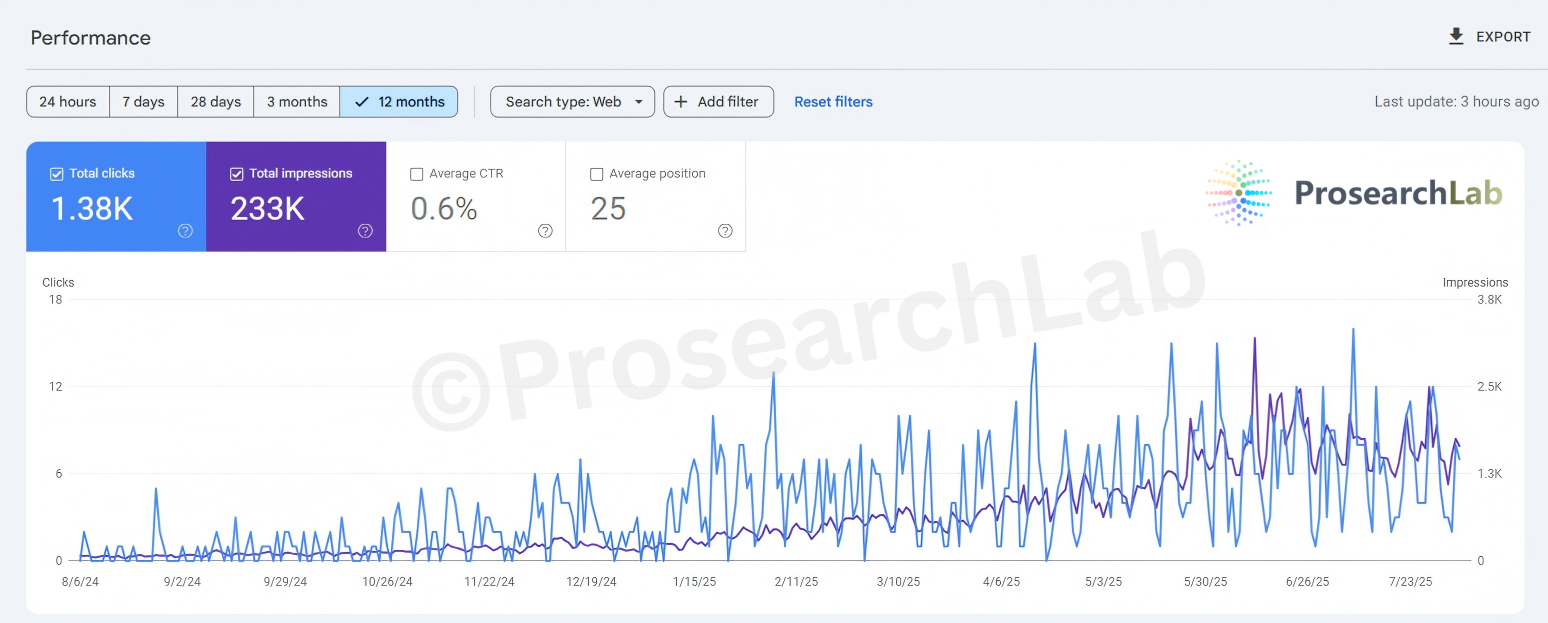
Figure 1. Impact of Architecture Flattening. The breakout in Impressions (Purple) starting Jan 2025 confirms the successful resolution of "deep crawl" issues, ending the 5-month stagnation.
Client Profile: B2B Smart Lock & Access Control Manufacturer (ODM/OEM)
Timeline: August 2024 – July 2025
Core Challenge: New Domain Sandbox + Deep Architecture Issues
1. Background: The Hidden Catalog Problem
In August 2024, the client launched a comprehensive digital catalog for their B2B smart lock series. However, for the first five months (August – December), the site experienced a zero-traffic flatline.
The Diagnostic Logic:
Our technical audit in December revealed why the site was invisible despite having content:
- Crawl Depth Issue: The valuable product pages were buried 5 clicks deep (Home > Products > Series > Year > Model). Googlebot rarely crawled past level 3 for a new domain with low authority.
- Semantic Void: The product pages relied on internal model numbers (e.g., "Model X-500"). There was no semantic mapping to industry terms like "biometric rim lock for glass doors." To Google, these looked like thin, duplicate content pages.
2. The Strategy: Flatten & Cluster (Deployed January 2025)
We executed a rigorous architectural overhaul to force Google to re-evaluate the site's value.
Phase A: Architecture Flattening (Technical)
- URL Structure: We moved all core product pages from
/products/category/series/model to /commercial-locks/model. This reduced crawl depth from 5 to 2. - Internal Linking: We implemented a "Related Applications" footer module. A lock used for hotels now linked directly to "Hospitality Solutions," creating a semantic loop that distributed link equity.
Phase B: The Entity Content Layer (Content)
We identified that B2B buyers (distributors/developers) don't search for model numbers; they search for specs and protocols.
- We rewrote metadata to target attributes rather than marketing fluff.
- Before: "High Quality Smart Lock."
- After: "Zigbee 3.0 Smart Mortise Lock | IP66 Waterproof | 6068 Lock Body."
- The Protocol Clusters: We published technical white papers on Matter, Zigbee, and Z-Wave integration. This wasn't just for reading; it was to build topical authority. This explains the massive surge in impressions (233K) in the chart—the site started ranking for high-volume technical questions.
3. Data Interpretation & Logic (The GSC Graph)
Referencing the performance timeline:
- The Dormant Phase (Aug '24 – Dec '24):
The flatline confirms the Orphaned Page hypothesis. The content existed, but without internal link pathways, Googlebot couldn't discover or prioritize the pages. The site was effectively in a self-imposed sandbox. - The Re-Crawl Lift (Jan '25 – April '25):
The divergence of the purple line (Impressions) starting in January marks the deployment of the Flattened Architecture. As Googlebot re-crawled the now-accessible pages, it began indexing the technical keywords.- Note on Low CTR (0.6%): This is expected and strategic. The site began appearing for broad informational queries (e.g., "what is Z-wave lock"). While these generate high impressions and low clicks, they signal to Google that the site is an authority, which boosts the ranking of money pages.
- The Intent Breakout (May '25 – July '25):
The volatility and upward trend in clicks (blue line) signify the commercial content taking hold. The spikes correlate with the site finally cracking Page 1 for specific long-tail B2B terms like "OEM fingerprint lock manufacturer USA" and "Tuya app compatible lock supplier."
4. Commercial Impact
- Traffic Quality: While 1.38K clicks seems low for B2C, for an OEM factory, this is substantial. The conversion data shows that users spending >3 minutes on the site are looking for MOQ (Minimum Order Quantity) of 500+ units.
- Inquiry Growth: The client went from receiving 0 organic inquiries in 2024 to receiving 12-15 qualified RFQs per month by Q2 2025.
- Cost Savings: The organic strategy replaced a failed Google Ads campaign that was costing $45 per click for generic terms.