Scaling SEO content sounds simple: publish more pages, target more keywords, cover more topics, build more topical authority, capture more organic traffic.
In practice, this is where many B2B websites start creating SEO problems faster than they create SEO value.
The issue isn't content scale itself. Large content libraries work extremely well when they're built with clear intent, strong architecture, useful internal links, and consistent quality standards. The problem begins when scale turns into uncontrolled production:
- A SaaS company publishes dozens of similar "best software for…" posts.
- A manufacturing site creates thin product-category pages for every small variation.
- A professional services firm builds overlapping pages for every industry, service, and location combination.
- An enterprise technology company fills a resource center with webinars, PDFs, and posts barely connected to commercial pages.
The result often isn't more qualified traffic. It's index bloat, duplicate content, weak page quality, unclear topical signals, and commercial pages that become harder for search engines to prioritize.
For B2B websites, scaling SEO content shouldn't mean producing as many URLs as possible. It should mean building a content system that helps the right buyers find the right pages at the right stage of their decision. This article explains how to do that—and how ProsearchLab approaches scalable content architecture for complex websites.
Executive Summary
- Scaling content is risky when teams optimize for publishing volume instead of search intent, page purpose, and commercial relevance.
- Low-value pages weaken indexation quality, waste crawl attention, create duplicate signals, and dilute internal authority.
- B2B content should be scaled around buyer journeys and commercially meaningful topic clusters—not raw keyword lists.
- Not every keyword deserves a standalone page. Many topics belong as sections inside stronger pages.
- A scalable system needs editorial rules, technical controls, internal linking standards, and periodic pruning.
The Real Problem With Scaling SEO Content
Most B2B companies don't set out to create low-value pages. The problem starts with reasonable goals: more organic visibility, broader coverage of buyer questions, closing keyword gaps, more pipeline from search, keeping pace with competitors.
Those goals are valid. But without a system, content scaling quietly becomes page multiplication. Every keyword becomes an article. Every industry becomes a landing page. Every feature becomes a post. Every campaign becomes a permanent indexed URL.
At first it looks productive—the site grows, the calendar is full, impressions may even rise. Over time, the cracks appear: pages compete with each other, search engines struggle to identify the best version of a topic, commercial pages receive fewer useful internal links, thin pages enter the index, and the resource center becomes hard to crawl and navigate. The website gets larger, but not stronger.
Content scale fails when teams measure output instead of usefulness. The better question isn't "How many pages can we publish?" It's "Which pages should exist, what role does each play, and how does each support qualified organic growth?"
Why Low-Value Pages Hurt B2B SEO
Low-value pages aren't just harmless pages that fail to rank. At scale, they change how a site is crawled, indexed, interpreted, and internally connected. (Google treats crawling and indexing as separate processes, and for large sites it explicitly recommends avoiding unnecessary low-value URLs that consume crawl resources.) For B2B sites specifically, they cause four connected problems.
They dilute site quality signals
When a library is full of thin, repetitive, or outdated pages, the whole site becomes harder to trust. This is common when companies publish near-identical pages with minor wording changes—for example, separate pages for "SEO consulting for SaaS companies," "for software companies," "for tech companies," and "for B2B tech companies" that all say almost the same thing. Individually each looks acceptable; together they create a weak content footprint.
They create index bloat
Index bloat happens when too many low-value URLs are discoverable or indexed: tag and author archives, internal search pages, filtered and parameter URLs, thin posts, duplicate landing pages, old campaign and event pages, near-identical product variations. On B2B sites this usually hides inside blogs, resource centers, product catalogs, and campaign directories. The problem isn't just that these pages exist—it's that they compete for crawl attention, add noise to Search Console, and make it harder to see which pages actually drive commercial visibility.
They weaken internal linking and cause cannibalization
Every page participates in the internal linking system. Too many low-value pages spread link equity thinly, so important service, product, and solution pages receive fewer contextual links than they need. This is a leading reason B2B sites attract informational traffic but fail to grow pipeline—the blog is active, the resource center is full, and the commercial pages are underlinked. That's an architecture problem, not a volume problem.
The same lack of ownership creates keyword cannibalization, where a blog post, a product page, a comparison page, and several old articles all chase "workflow automation software." Search engines rotate rankings, pick a weaker page, or rank none of them strongly. A good system prevents this before pages are published.
They disconnect traffic from pipeline
Not all organic traffic is valuable. A site can grow traffic with broad "what is" posts, glossary pages, and trend articles—some of which is useful—but if it never connects to buyer problems or commercial pages, it becomes vanity traffic. SEO looks successful in analytics while business impact stays flat. The goal isn't traffic growth alone; it's qualified visibility that supports the buyer journey.
What Counts as a Low-Value Page?
A low-value page isn't always short. A 2,000-word article can still be low value if it has no clear purpose, repeats existing content, or targets the wrong audience. On B2B sites, they tend to fall into six categories.
Thin pages have too little useful information to satisfy the searcher—product pages with only a few specs, generic service copy, industry pages that just swap the industry name, webinar pages with no summary, case studies with no outcome, posts that restate basic definitions without insight. These are especially risky on competitive B2B queries where buyers need depth and confidence.
Duplicate or near-duplicate pages don't need to be exact copies. Template-driven location, industry, product-variation, integration, comparison, and partner pages often change only the title while the body stays the same. If each page doesn't provide distinct value, you're creating URLs, not search assets.
Search-intent mismatch pages are well written but aimed at the wrong intent—a post explaining "what an enterprise SEO audit is" when the searcher wants a vendor, checklist, or pricing model. This is why intent mapping has to happen before writing.
Orphan or unsupported pages may be useful but have no internal links and belong to no cluster. Common with campaign, resource, event, and standalone SEO landing pages built outside the main architecture, they struggle because they have no topical context or internal authority.
Outdated pages still appear in search but no longer reflect current products, positioning, pricing, regulations, or buyer expectations—a particular risk for SaaS, enterprise tech, cybersecurity, manufacturing, compliance, and professional services.
Pages with no business role. Not every page must convert, but each should have a reason to exist: problem awareness, technical education, vendor evaluation, product understanding, industry credibility, internal linking, sales enablement, thought leadership, proof, or conversion. If a page does none of these, question it.
How to Scale SEO Content the Right Way
Scaling safely requires a system that defines which topics deserve pages, which should be consolidated, how pages connect to commercial goals, and how quality is maintained over time.
Start with commercial architecture
Before building a content calendar, map the pages that represent the business model: core service, product, solution, industry, use-case, integration, and comparison pages, plus demo/consultation pages, case studies, and pricing where applicable. These become the center of the system.
Content should be scaled around the pages that matter most to pipeline—not around random keyword opportunities. If a SaaS company wants to rank for workflow automation, the strategy isn't twenty blog posts about automation; it's a structured cluster that supports the main workflow automation product or solution page.
Build topic clusters, not content piles
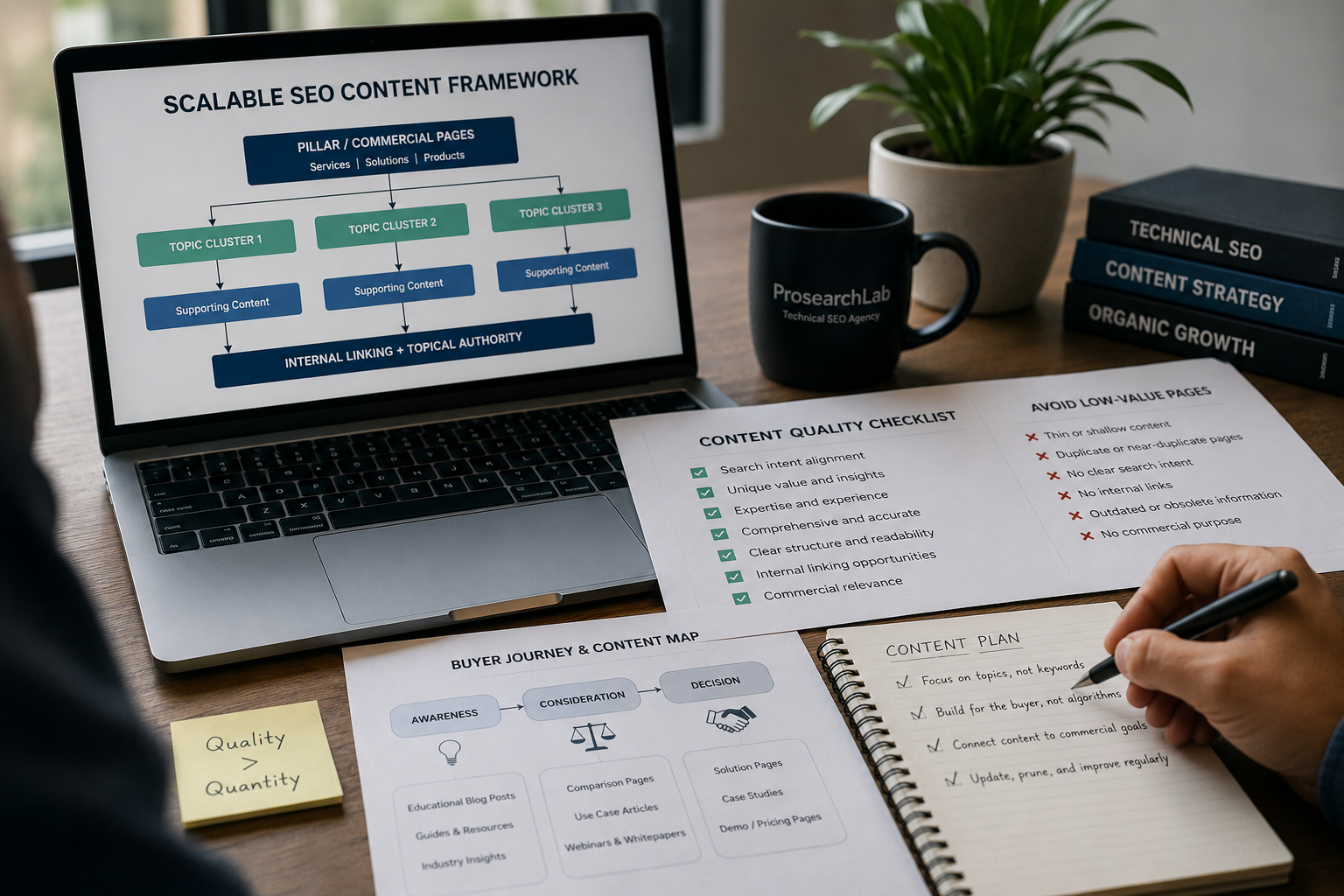
A content pile is a set of loosely related posts. A topic cluster is a structure where every page has a role: the hub targets the main commercial topic, supporting articles answer specific buyer questions, comparison pages serve evaluation-stage searches, case studies provide proof, technical resources address implementation, and internal links tie it together.
For example, a technical SEO agency might build a cluster around indexation:
- Hub / service page: Technical SEO Audit
- Supporting posts: Indexation SEO Checklist for B2B Websites · How to Fix "Crawled but Not Indexed" Pages · Canonical Tags for B2B Websites · Internal Linking for Commercial Pages
- Supporting resource: Technical SEO Audit Checklist
- Proof: Site Migration SEO case study
This is far stronger than unrelated posts that merely mention "technical SEO."
Decide when a topic deserves its own page
Not every keyword should become a standalone page. Before creating one, ask: Is the intent distinct? Is there enough depth for a full page? Will it compete with an existing page? Can we answer better than what already ranks? Does it support a commercial page? Will it attract the right audience? Can it be internally linked naturally? Will we maintain it?
If the answers are weak, the topic is usually better handled as a section inside an existing page. This is one of the most important rules for scaling B2B content: a strong page with well-organized sections beats five thin pages targeting slight keyword variations.
Create content tiers
A scalable strategy doesn't treat every page the same. Four tiers help:
- Tier 1 — Commercial pages: service, product, solution, industry, and demo pages. Deeply reviewed, heavily internally linked, closely monitored in Search Console.
- Tier 2 — Strategic support content: buying guides, technical explainers, comparisons, integration and implementation content, high-intent posts. These link clearly to Tier 1.
- Tier 3 — Educational / awareness content: earlier-stage questions that may not convert directly but build topical authority and guide readers toward commercial resources.
- Tier 4 — Temporary / low-search utility pages: event, announcement, and campaign pages. Many should be noindexed, consolidated, or removed after their useful period.
Tiering stops teams from treating every URL as an SEO asset.
Use internal linking as a scaling control
Plan internal links before publishing. Every new page should answer three questions: Where will it receive links from? Which pages will it link to? Which commercial page does it support? If a page has no natural link path, it probably doesn't belong in the strategy.
Strong internal linking improves discovery, reinforces topical relationships, passes authority to commercial pages, reduces orphans, and clarifies page importance. Links should be crawlable and use descriptive anchor text—part of the content brief, not something added randomly after publication.
Set editorial standards for scaled content
Scaling without editorial standards is how low-value pages get made. A useful B2B brief specifies target intent, primary audience, buyer-journey stage, the commercial page supported, required internal links, pages to avoid competing with, required examples and subject-matter input, the differentiation angle, update requirements, and the conversion path.
Premium B2B content should show some combination of specific buyer knowledge, technical clarity, decision criteria, real-world implementation context, commercial relevance, clear structure, and useful next steps. The goal isn't to make every article long—it's to make every article purposeful.
Apply strict quality controls to programmatic SEO
Programmatic SEO can work, but for B2B it's risky without page-level value standards. Risky patterns include industry pages with only the name changed, location pages with duplicated service copy, integration pages with no integration-specific detail, shallow comparison pages, mass glossary generation, and AI-generated posts with minimal review.
Before scaling any template, define what must be genuinely unique on every page: intent, audience problem, use case, examples, product relevance, FAQs, internal links, proof points, conversion path, and metadata. If those elements can't be made distinct, the page probably shouldn't exist.
Audit existing content before publishing more
Many B2B sites don't need more content immediately—they need a better inventory. Before scaling, classify existing pages as keep, update, consolidate, redirect, noindex, or delete. This often reveals that valuable assets already exist but are outdated, underlinked, duplicated, or poorly positioned: a page-two post that becomes valuable once updated and linked to a service page; three overlapping articles that merge into one stronger guide; a thin industry page that becomes a real landing page with use cases and proof. Scaling should start by strengthening the foundation. (For the technical side of this cleanup, see our indexation SEO checklist.)
Measure the right things
Publishing velocity is the wrong primary metric. Better ones include: indexed priority pages, impressions for commercial page groups, internal links to Tier 1 pages, number of orphan and near-duplicate pages, "crawled but not indexed" priority URLs, assisted conversions from organic content, demo/contact visits from organic users, and revenue-page visibility by topic cluster. These reveal whether scale is improving the search system or just expanding the URL count.
How ProsearchLab Approaches Scalable SEO Content
At ProsearchLab, scalable content is a content-architecture and technical-SEO challenge, not just a writing project. The process starts by reviewing commercial priorities—which pages should drive qualified visibility, which topics support them, and where the current architecture is weak.
A scalable content engagement may include commercial page mapping, topic cluster planning, keyword-to-intent mapping, content inventory and duplicate analysis, indexation review, internal linking strategy, pruning recommendations, editorial brief templates, page-type quality standards, technical checks for templates, and ongoing governance.
The goal isn't more content for its own sake. It's a search system where every important page has a clear role, every supporting page strengthens the structure, and low-value URLs are controlled before they dilute visibility. This matters most for B2B, SaaS, manufacturing, enterprise technology, and professional services sites, where buyers search by problem, product, industry, use case, integration, comparison, and risk—complexity that content scale has to reflect without turning the site into a cluttered library of weak pages.
When to Get SEO Support Before Scaling Content
Consider technical SEO or content architecture support before scaling if you're seeing:
- Blog traffic growing while pipeline stays flat
- Many pages "crawled but not indexed"
- Multiple pages targeting similar keywords
- Weak organic visibility for commercial pages
- A backlog of old, thin, or duplicate pages
- Inconsistent internal linking
- Plans for programmatic SEO or large-scale AI-assisted content
- A large resource center, or poorly connected product/service/industry pages
- Many duplicate or alternate URLs in Search Console
- An upcoming redesign or CMS migration
The earlier these are addressed, the easier it is to scale safely. Once a site has thousands of low-value URLs, cleanup becomes slow and complex.
Final Thoughts
Scaling SEO content isn't about publishing more pages. It's about building a stronger search architecture where every new page has a clear purpose—serving a real intent, supporting a buyer journey, connecting to commercial pages, and strengthening the site's topical structure. Low-value pages do the opposite: they dilute signals, consume crawl attention, create duplication, and bury the pages that matter.
A mature content strategy asks fewer volume questions and more strategic ones: Should this page exist? What role does it play? Which buyer does it help? Which commercial page does it support? How will it be discovered and maintained? What happens if it stops being useful? Scaled with that discipline, SEO stops being publishing and becomes a system for building qualified visibility and pipeline.
ProsearchLab helps B2B companies scale SEO content without creating low-value pages, index bloat, or disconnected libraries. Book a content architecture review and we'll map your commercial pages, priority clusters, and pruning opportunities—so you can grow content that search engines understand and qualified buyers actually use.